Project created by James Sielatycki, AJ Morris, Wanye Davis, and Ke Wang.
Ardipithecus and Lucy Discovery
Ardipithecus is 4.4 million years old. She was bipedal, which means she walked on two legs. Ardi also the oldest hominid in the primate family tree. Ardi is the closet thing found to be the common ancestor of humans and chimps.Hominids are all fossil species closer to modern humans than to chimps Ardi walked upright. She stood about 47 inches tall and weighed about 110 pounds. Scientists think that she was able to climb trees because her feet were used to grasping. Her teeth resemble modern human teeth more closely than they do those of a chimpanzee.
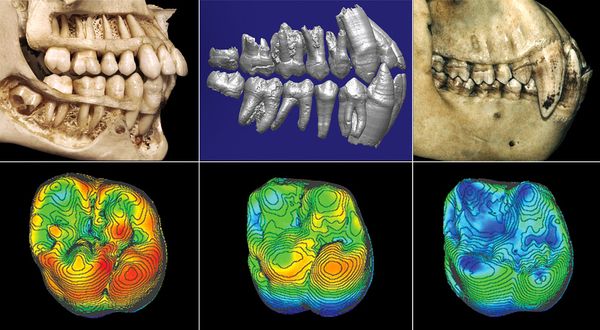 In this picture, the photo to the left is a humans jawbone, right chimpanzees, and in the middle is Ardi's. Ardi's teeth are midway between humans and chimpanzees in size. | The anthropologists found the bones in Ethiopia, in a desert region called Aramis. The team spent almost two decades collecting everything from animal bones to pollen in the region. Some experts say that the discovery of Ardi revolutinized the understanding of evolution.
|
Is Ardi the Missing Link?
The fossils of Australopithecus afarensis (Lucy) and Ardipithecus ramidus (Ardi) are shown below. Lucy lived 3.2 million years ago and the bone structure of her knee cap, pelvis, and femur suggest she walked upright. She also had molars and front teeth, similar to humans. Up until Ardi was discoverd, she was the oldest known hominid. is similar to humans because she walked upright and also on all fours. Her pelvic muscles, like Lucy, suggest that she was bipedal. She is similar to apes because of her divergent left toe that could grasp branches when climbing trees. Ardi's teeth size also suggest that there was little male-to-male conflict in her species.
Ardi is believed to have been the "missing link" in human evolution because of her similarities between both humans and ape-like creatures.
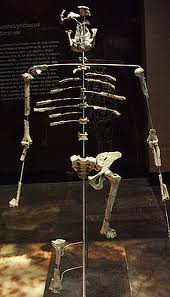 Australopithecus afarensis | 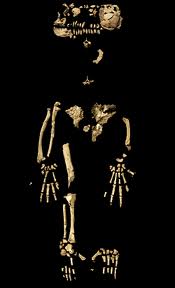 Ardipithecus ramidus |
Evidences of Evolution The appearance of vestigial organs in organisms is an example of evolution. Human tailbones seem to have no function because we don't have tails. Also, flightless birds like ostriches still have wings. These vestigial structures and organs were necessary in ancestors but became unnecessary in future generations. 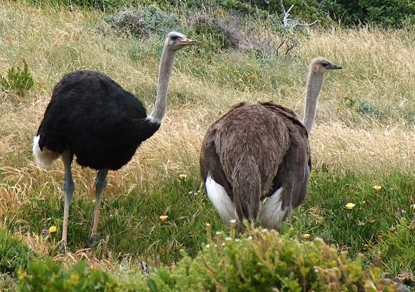 |
Antother evidence of evolution is that hippos have more DNA in common with whales and dolphins than any other animal. The skeletons of these animals can be traced back to hooved mammals that lived near water. An ancient water mammal named Basilosaurus had tiny back legs but only lived underwater. Below is a picture of this ancient whale. 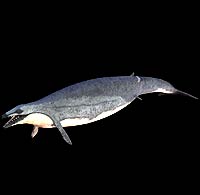 An example of biochemical evolution is that a protien necessary for aerobic respiration called cytochrome c is in all organisms that go through respiration. Another example is that the genetic code in most organisms is close to identical. Most organisms go through the same processes of protien synthesis. |
An embryotical example of evolution is the change in the pharyngeal structures of humans and fish. During development these structures become gill supports for fish and in humans, they form a structure in our ear that helps us hear. Another example is that humans, chickens, frogs, rabbits, and fish are very similar in the early stages of their developement. 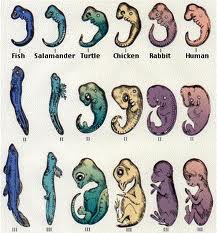 |
Historical Views of Evolution
Jean Baptise Lamarck (1744-1829) was a French naturalist who proposed theories about evolution and adaptation of organisms through natural processes. His ideas were attacked and caused great controversy. Lamarck proposed his idea that simple organisms could become more complex because of nature. An example he gave was that if a giraffe stretched it's neck enough to reach higher leaves, the neck would stay that way. When the same giraffe mated, it's offspring would have the trait of a longer neck. This theory is not supported. Another one of his theories was that if an organism stopped using organs than they would eventually go away. For example, if a bird stopped using it's wings than they would keep on getting smaller through generations and eventually disappear. This theory is also not supported. |
Darwin's theory of Natural Selection
- Organisms produce more offspring than sustainable.
- Individuals have variation.
- Individuals with favorable variations survive and pass the traits to offspring.
- Offspring with certain variations make up most of the population and may look different from ancestors.
Darwin was influenced by other naturalists of his time including Lamark, Lyell, Malthus, and others. He gathered a great amount of his information and data from a voyage to the Galapagos islands. Darwin noticed slight variations in tortoises that made them recognizably distinct from island to island. He also studied variations in physical characteristics of finches on the island. He noticed that they had differences but appeared to come from the same ancestor. His theories are still supported to this day.
Darwin's tortoise 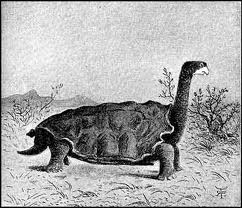 | Darwin's finches 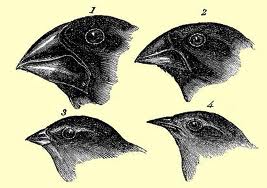 |
Evolution: Sexual Reproduction and Speciation
Sexual Reproduction playes a key role in evolution because without it, evolution probably wouldn't have happened and wouldn't be happening currently. Reproduction allows for variation in species because of mutations or inheritance of traits. A main aspect in the theory of evolution is variation and without sexual reproduction, there would be little to no variation. | Speciation is defined as "the formation of a new species as a result of evolutionary processes". It plays a key role in evolution because it introduces new species. Speciation occurs from two ways: geographic isolation and reproductive isolation. Geo isolation is when a physical barrier prevents breeding, leading to reproductive isolation. Examples of physical barriers are hurricanes, volcanic eruptions, or rivers. When species are relocated to a new environment they adapt and develop new traits. Their offspring will get these traits, leading to variation. |
An example of modern day evolution would be the peppered moth. The moth originally blended in with light color lichens on trees. During the Industrial Revolution, the soot and pollution killed the light colored lichens and turned the trees black. Over time, the light colored moths were killed off and dark colored ones thrived because they were better camoflauged. The successful black moths kept reproducing and passed on the dark colored trait. | 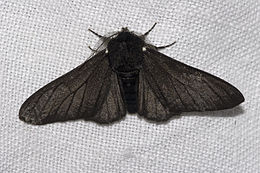 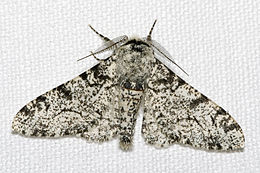 |
SOURCES
http://news.discovery.com/history/ardi-human-ancestor.html
http://www.crystalinks.com/lucy.html
http://anthro.palomar.edu/evolve/evolve_3.htm
http://www.teachthemscience.org/evidence
http://www.darwins-theory-of-evolution.com/
http://www.globalchange.umich.edu/globalchange1/current/lectures/selection/selection.html
http://www.globalchange.umich.edu/globalchange1/current/lectures/speciation/speciation.html
http://www.truthinscience.org.uk/tis2/index.php/component/content/article/127.html
